The Complete Chronicle of the Emperors of Rome (Vol. 1) by Roger M. Kean & Oliver Frey
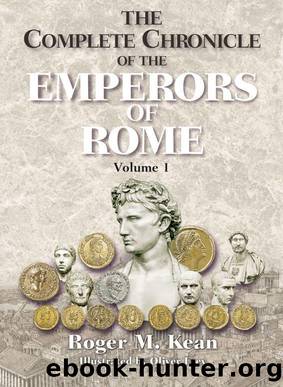
Author:Roger M. Kean & Oliver Frey [Kean, Roger M. & Frey, Oliver]
Language: eng
Format: epub
Amazon: B0097SBTJM
Publisher: Reckless Books
Published: 2012-09-06T22:00:00+00:00
Hadrian’s Administration
The provinces benefited from Hadrian’s imperial perambulations, although in the first instance the cost of receiving the emperor and his “burdensome” retinue fell on the cities, colonies, and municipia no matter how modestly Hadrian comported himself. In almost all cases, however, the provincials received far more than they had to give. Hadrian undertook public works wherever he went; new roads and bridges, aqueducts, modern harbors, lavish temples, public baths, and games. Ephesus and Trapezus received new harbor installations, he built aqueducts at Athens and Corinth, and new roads were laid and bridges raised as far apart as Hispania and easternmost Moesia Inferior. In addition Hadrian was Rome’s greatest city-builder. New cities sprang up all over the empire, many in the Danubian provinces. From Forum Hadriani in the extreme north (Voorburg-Arentsburg, Holland) to Colonia Julia Hadriana Avenio (Avignon) in Gaul, Hadrian’s civic engineers were at work throughout his reign. The most famous is Hadrianopolis in Thracia, known better today as Adrianople (although it was renamed Edirne in the fifteenth century by the Ottoman Turks). Not every civil scheme met with approval, however: the rebuilding of Jerusalem was to be the cause of a dangerous rebellion.
As a part of his consolidation of the frontiers Hadrian extended municipal rights to many of the settlements that had sprung up around the great frontier legionary camps. None of his predecessors had allowed any such towns charters as municipia. In contrast he contemplated evacuating Dacia to conserve military resources, but was persuaded against a move that would have left so many recent settlers at the mercy of the local tribes. While the provinces gained much from Hadrian’s construction activity and travels, adlection into the senate continued to deprive the provincial cities of wealthy and experienced administrators. As a consequence Hadrian was obliged to follow Trajan’s precedent of sending in his own curatores to administer financially embarrassed localities.
Hadrian’s attention to detail is also to be found in his famous codification of Roman law, also known as the Codification of the Praetor’s Edict. In one respect, this can be seen as bringing within the principate’s autocratic control an element of Roman life that had been allowed to escape it. On the other hand, it benefited citizens by providing a standard interpretation of the complex judicial processes that had grown up since the mid-Republican era. At that point in time the urban praetors began to issue a statement of the program of legal procedure and interpretation that each proposed to follow during his term of office. In theory this fixed how the laws would be interpreted from that point on. However, his successor in office was not bound by this edictum perpetuum, in fact it was only when the Lex Cornelia of 67 BC was passed that a praetor was even obliged to abide by his own edict, let alone that of his predecessors.
Nevertheless, situations would arise in which, to suit the circumstances of the case being heard, the praetor needed to add to the body of law
Download
This site does not store any files on its server. We only index and link to content provided by other sites. Please contact the content providers to delete copyright contents if any and email us, we'll remove relevant links or contents immediately.
Personalized inhaled bacteriophage therapy for treatment of multidrug-resistant Pseudomonas aeruginosa in cystic fibrosis by unknow(213597)
CONSORT 2025 statement: updated guideline for reporting randomized trials by unknow(102515)
Critical evaluation of the ProfiLER-02 study design and outcomes by Vivek Subbiah & Razelle Kurzrock(102039)
Cardiac gene therapy makes a comeback by Oliver J. Müller & Susanne Hille & Anca Kliesow Remes(101833)
Whisky: Malt Whiskies of Scotland (Collins Little Books) by dominic roskrow(74615)
Unveiling the design rules for tunable emission in graphene quantum dots: A high-throughput TDDFT and machine learning perspective by Şener Özönder & Mustafa Coşkun Özdemir & Caner Ünlü(50996)
A yeast-based oral therapeutic delivers immune checkpoint inhibitors to reduce intestinal tumor burden by unknow(40370)
Covalent hitchhikers guide proteins to the nucleus by Alexander F. Russell & Madeline F. Currie & Champak Chatterjee(40294)
Meet the Authors: Christopher R. Mansfield and Emily R. Derbyshire by Christopher R. Mansfield & Emily R. Derbyshire(40204)
Alkaline-earth metals promote propane dehydrogenation with carbon dioxide through geometric effects: Altering the reaction pathway by unknow(32812)
Induced iron vacancies boosting FeOOH loaded on sustainable Fenton-like collagen fiber membrane for efficient removal of emerging contaminants by unknow(32607)
Efficient electric-field-assisted photochemical conversion of methane to n-propanol exclusively over penetrated TiO2Ti hollow fibers by Guanghui Feng(32527)
Bi2SiO5 nanosheets as piezo-photocatalyst for efficient degradation of 2,4-Dichlorophenol by Hangyu Shi & Yifu Li & Lishan Zhang & Guoguan Liu & Qian Zhang & Xuan Ru & Shan Zhong(32464)
A novel NDIPTA organic heterojunction photocatalyst with built-in electric field for efficient hydrogen production by Jiahui Yang & Baojun Ma & Yongfa Zhu(32437)
Enhanced conversion of methane to liquid-phase oxygenates via hollow ferrite nanotube@horseradish peroxidase based photoenzymatic catalysis by Jun Duan & Shiying Fan & Xinyong Li & Shaomin Liu(32403)
Ordered macroporous superstructure of defective carbon adorned with tiny cobalt sulfide for selective electrocatalytic hydrogenation of cinnamaldehyde by Xiao-Shi Yuan & Sheng-Hua Zhou & San-Mei Wang & Wenbo Wei & Xiaofang Li & Xin-Tao Wu & Qi-Long Zhu(32330)
What's Done in Darkness by Kayla Perrin(27245)
Topological analysis of non-conjugated ethylene oxide cored dendrimers decorated with tetraphenylethylene: Insights from degree-based descriptors using the polynomial approach by A Theertha Nair & D Antony Xavier & Annmaria Baby & S Akhila(26627)
Investigation of mechanical and self-healing properties of hydroxyl-terminated polybutadiene functionalized with 2-ureido-4-pyrimidinone by Mohsen Kazazi & Mehran Hayaty & Ali Mousaviazar(26553)
